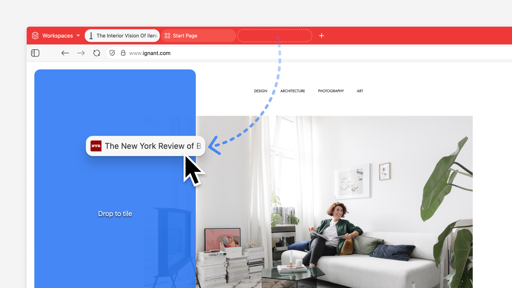
With this release we’re raising the bar for Tab Tiling, with drag-and-drop tiling and opening links directly into tiled tabs. Alongside stability improvements and a set of carefully chosen refinements…
I think that some people don’t like Chromium, because it was made by Google, or better Google forked it from the German KHTML engine by KDE. Chromium is 100% FOSS and everybody can modify it to the like, gutting the Google Spy APIs, which is done by eg. degoogled Chromium and also Vivaldi. Because this it matters less that it is an Chromium, not sponsored by Google, like Mozilla with breathing Alphabet INC in your neck, nor by anyone else, there are no third party sponsors supporting Vivaldi.
Blink (Chromium) is the best engine for current webformats, because it’s the most used and because of this most webs are optimized for it.
Only if you use Chromium as such, but not if you use an fork without Googles tracking APIs. You give Google power using his services, Google search, his AIs or makes a contract with his support. but not using an modified FOSS browserengine. Do you think that EDGE helps Google?
Why do you think it’s so well supported by web standards? Because Google can *make * the web standards when everyone uses their engine. And they don’t do it for good.
Not really, it’s use and fork an FOSS, the webstandard is a response of the most used system to access it, which is Chromium (Blink), it really benefits only the webmasters because this standard. Both other engines only can try to emulate this differences. The real problem is that since more than 20 years there isn’t any new engine apart Blink, Gecko and WebKit + some few exotic forks of these (Goanna, Qt…), not really usefull for modern Browsers. The engine is by far the most complex part of an browser and to develope a new engine is a work for a lot of devs for years. There are some attempts (eg. Ladybird) where we maybe can see an stable release in two - three years, if they don’t abandon it before like some others.
Even the maintance of the engine is a lot of work, not really affordable for single devs, needed to permanently check for security holes which permanently ocurres due new malware in the network (thousends every day, specially now in the current world situation) and release corresponding patches.
Vivaldi is always 2 Chromium versions behind (except security patches), because the need to gut the Chromium engine and modify it for 6 different OS (Windows, Linux, Mac, Androud, Android Auto, iOS) before the new release. Hard work for this small cooperative in Norway.
A small part of Vivaldi, related to the unique UI, is proprietary, source available, not closed source. So Chrome and EDGE can’t use it legally. Gecko browser have it easier to release as FOSS, there are no big corporations which use it.
Quite aware of all that and you conveniently sidestepped the issue with Google doing the bulk of that work and dictating the future of the web. It’s the new ie6 which was never a good thing.
If you can’t see that then there’s zero reason to discuss further.
The other is Mozilla apologism, even more in hands of Google or WebKit apologism in hands of Apple AND Google. Google dominate Web standarts, that is a fact because of its story as reference company in Internet. It’s not about browser engines, it’s nowadays irrelevant which you use and certainly not the point of the Google incommings.
Same as with the discussions of the end of Mv2 and everybody said that is a problem for Chromium, relaying on the Chrome Store, Certainly with Chromium 146 ends the support of Mv2, but it will sooner or later also end for all other browsers, like in 2013 the end of Mv1.
Mv3 is a new standart for extensions, which limit somewhat the amount of filters in the adblocking, but improved the privacy due a different cookie handling. In real tests the difference is irrelevant for the user (eg. Adblock Plus is currently Mv3). Also irrelevant for browsers with inbuild adblockers, whose filterlists don’t depends on Google. Apart beeing a new standart means for the devs the maintance and release of two versions of their extensions, Mv2 and Mv3, to be able to stay in the stores, means also that NOBODY would support Mv2 for infinite, even not Firefox and forks, at least if they don’t also include an ad/trackerblocker in the browsers with independent filterlists.
Yeah sure. Im trusting Google with privacy. Eye roll
Go peddle the apologism elsewhere. Besides that, give Google time convincing people like you manifest 3 is fine before they make it even worse so you can’t block ads. Imagine trusting an AD COMPANY to make the internet better.


I think that some people don’t like Chromium, because it was made by Google, or better Google forked it from the German KHTML engine by KDE. Chromium is 100% FOSS and everybody can modify it to the like, gutting the Google Spy APIs, which is done by eg. degoogled Chromium and also Vivaldi. Because this it matters less that it is an Chromium, not sponsored by Google, like Mozilla with breathing Alphabet INC in your neck, nor by anyone else, there are no third party sponsors supporting Vivaldi. Blink (Chromium) is the best engine for current webformats, because it’s the most used and because of this most webs are optimized for it.
So the fact that it is based on chromium does nothing to help Google? And doesn’t give them any more power?
Only if you use Chromium as such, but not if you use an fork without Googles tracking APIs. You give Google power using his services, Google search, his AIs or makes a contract with his support. but not using an modified FOSS browserengine. Do you think that EDGE helps Google?
Yes… Very much so.
Why do you think it’s so well supported by web standards? Because Google can *make * the web standards when everyone uses their engine. And they don’t do it for good.
So yes, every chrome variant does help Google.
Not really, it’s use and fork an FOSS, the webstandard is a response of the most used system to access it, which is Chromium (Blink), it really benefits only the webmasters because this standard. Both other engines only can try to emulate this differences. The real problem is that since more than 20 years there isn’t any new engine apart Blink, Gecko and WebKit + some few exotic forks of these (Goanna, Qt…), not really usefull for modern Browsers. The engine is by far the most complex part of an browser and to develope a new engine is a work for a lot of devs for years. There are some attempts (eg. Ladybird) where we maybe can see an stable release in two - three years, if they don’t abandon it before like some others.
Even the maintance of the engine is a lot of work, not really affordable for single devs, needed to permanently check for security holes which permanently ocurres due new malware in the network (thousends every day, specially now in the current world situation) and release corresponding patches. Vivaldi is always 2 Chromium versions behind (except security patches), because the need to gut the Chromium engine and modify it for 6 different OS (Windows, Linux, Mac, Androud, Android Auto, iOS) before the new release. Hard work for this small cooperative in Norway.
A small part of Vivaldi, related to the unique UI, is proprietary, source available, not closed source. So Chrome and EDGE can’t use it legally. Gecko browser have it easier to release as FOSS, there are no big corporations which use it.
https://github.com/ric2b/Vivaldi-browser
Quite aware of all that and you conveniently sidestepped the issue with Google doing the bulk of that work and dictating the future of the web. It’s the new ie6 which was never a good thing.
If you can’t see that then there’s zero reason to discuss further.
This is just Google and Vivaldi apologism.
The other is Mozilla apologism, even more in hands of Google or WebKit apologism in hands of Apple AND Google. Google dominate Web standarts, that is a fact because of its story as reference company in Internet. It’s not about browser engines, it’s nowadays irrelevant which you use and certainly not the point of the Google incommings. Same as with the discussions of the end of Mv2 and everybody said that is a problem for Chromium, relaying on the Chrome Store, Certainly with Chromium 146 ends the support of Mv2, but it will sooner or later also end for all other browsers, like in 2013 the end of Mv1.
Mv3 is a new standart for extensions, which limit somewhat the amount of filters in the adblocking, but improved the privacy due a different cookie handling. In real tests the difference is irrelevant for the user (eg. Adblock Plus is currently Mv3). Also irrelevant for browsers with inbuild adblockers, whose filterlists don’t depends on Google. Apart beeing a new standart means for the devs the maintance and release of two versions of their extensions, Mv2 and Mv3, to be able to stay in the stores, means also that NOBODY would support Mv2 for infinite, even not Firefox and forks, at least if they don’t also include an ad/trackerblocker in the browsers with independent filterlists.
That are the facts, without Vivaldi apologism.
Yeah sure. Im trusting Google with privacy. Eye roll
Go peddle the apologism elsewhere. Besides that, give Google time convincing people like you manifest 3 is fine before they make it even worse so you can’t block ads. Imagine trusting an AD COMPANY to make the internet better.
Head firmly in the sand.