

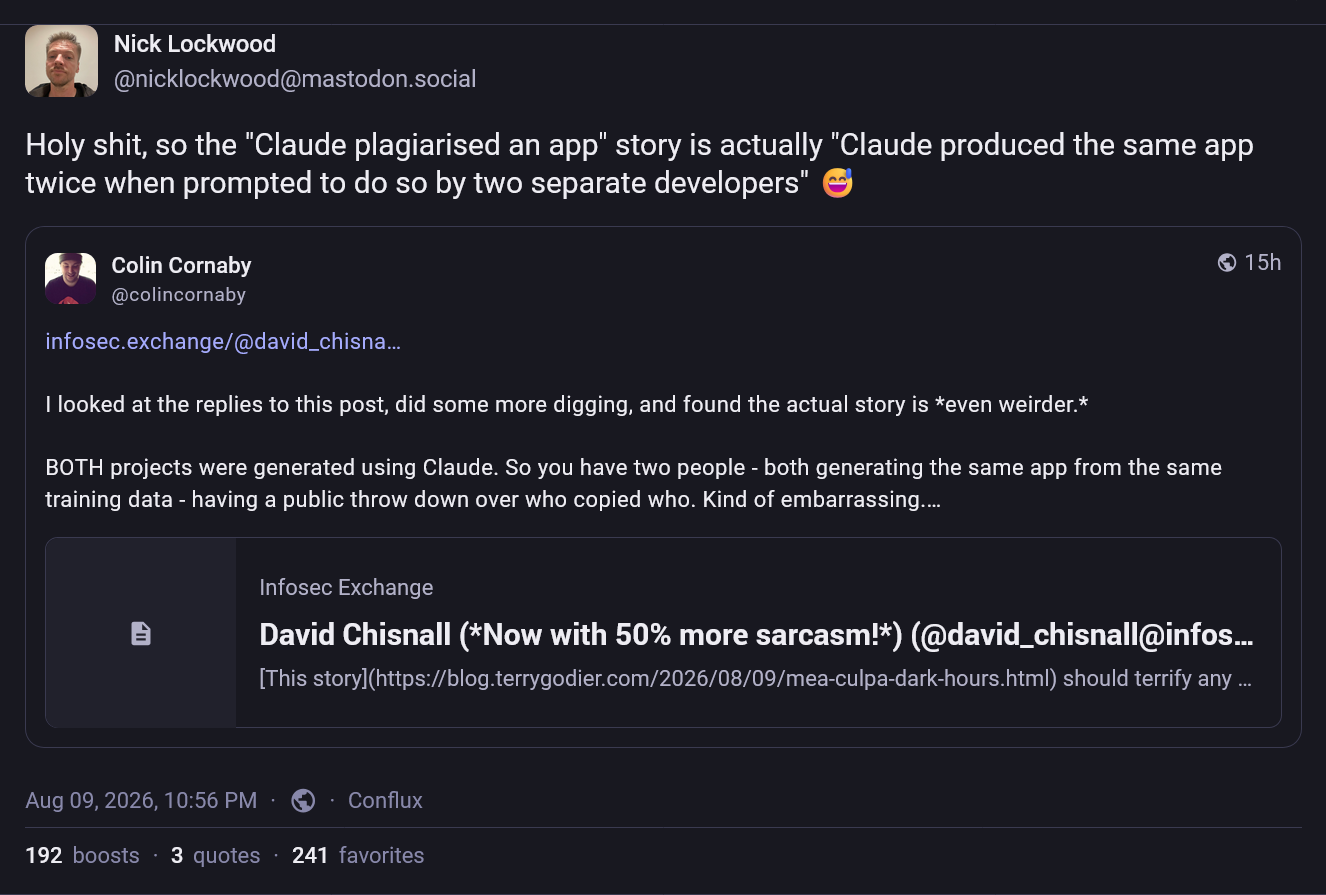
Link to post: https://mastodon.social/@nicklockwood/117069670583842298
Short version: Two seperate “vibe-coders” used Claude to create an app–which turned out identical. And then the coders went after each other.
Transcript
Nick Lockwood: Holy shit, so the “Claude plagiarised an app” story is actually “Claude produced the same app twice when prompted to do so by two separate developers” 😅
Colin Cornaby
infosec.exchange/@david_chisnall/117066183348062085
I looked at the replies to this post, did some more digging, and found the actual story is even weirder.
BOTH projects were generated using Claude. So you have two people - both generating the same app from the same training data - having a public throw down over who copied who. Kind of embarrassing.
I had an intern this summer working on a project that involved mapping two data sets based on a description field. I showed him how to write a Python script using a fuzzy matching library to compare the two data sets and find matches. We then talked through the downsides of using a contextless string comparison and the situations that create false positives and false negatives.
We then tried to use a few of the AI tools to match them, hoping to demonstrate how a tool that understands context can do a better job at the expense of far more computation. All they would do was write and run a Python script using the same library, but every request would start with writing a new, slightly different script. Incredibly wasteful.
It turned into a great demo of how even if it returns a useful result, it’s rarely better than a person could do in a few minutes and is far less consistent.
You CAN just tell the AI to create a reusable script for itself to use on future runs, even ask it to think of what the parameters are that would be likely to change between runs.