I’m not sure that’s been extensively tested in courts. The document you referenced below appears to be as-yet not officially published, so I don’t believe it actually qualifies as an official position yet, but the bigger issue is that it’s untested in court.
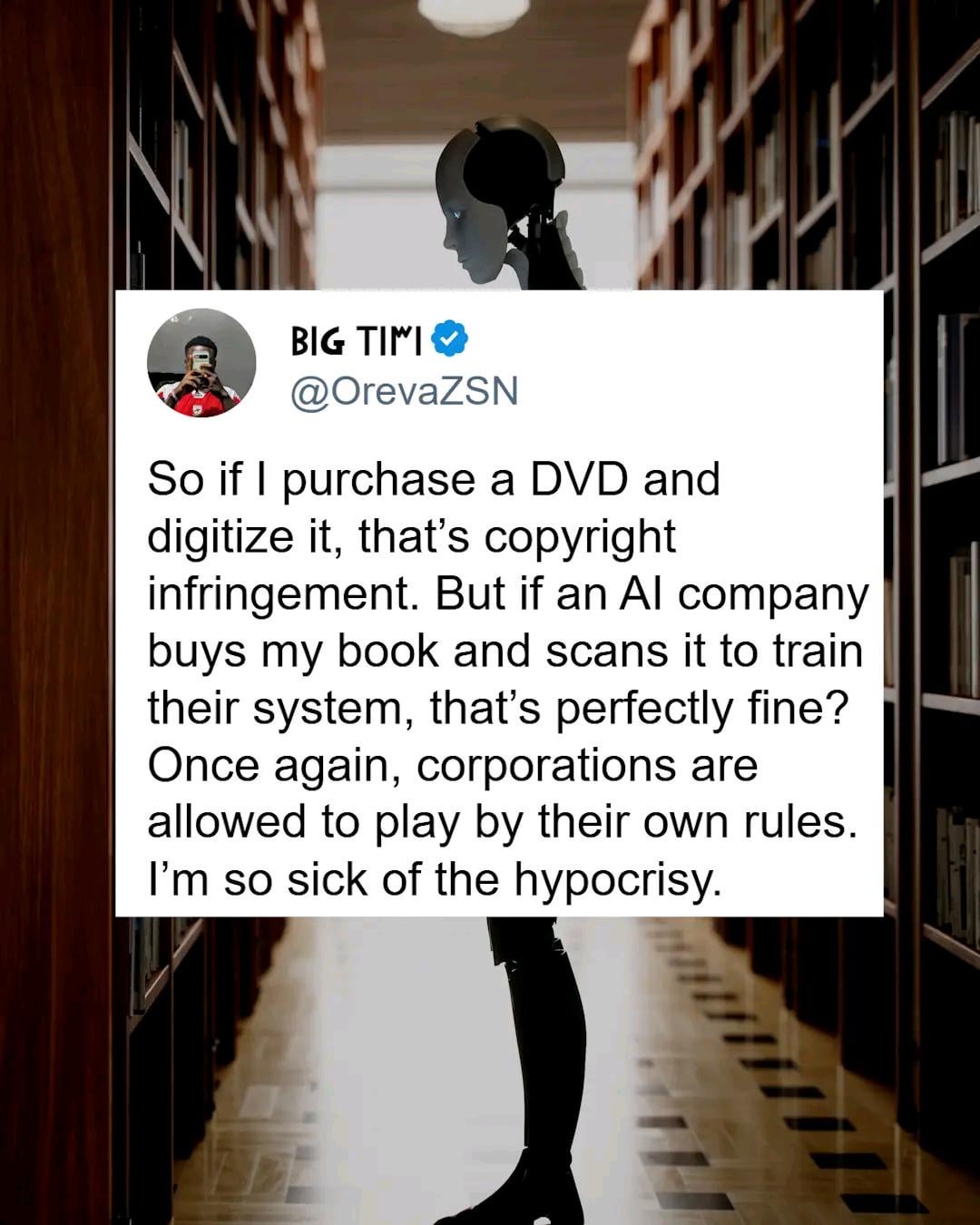
This thread is a response to an AI court case where the ruling was that training on copy written works is fair use.
Alsup ruled in June that Anthropic made fair use of the authors’ work to train Claude, but found that the company violated their rights by saving more than 7 million pirated books to a “central library” that would not necessarily be used for that purpose
Regardless, you do make good points and I think we agree that the end state is “they shouldn’t be able to do that”. I have concerns that using existing standards that take copying too literally results in some unintended ambiguity, and situations where AI training is incidentally blocked, but so is stuff like “opening a news article on a computer”, which does the same things the copyright office report highlights as infringement.
I think we’d be in a much more agreeable place if we just legally state that a commercial AI tools training isn’t fair use. That lets you have nuance like “search engine? It’s a statistical model, but not generative: allowed. AI agent? Statistical model that’s generating content as opposed to classification or ranking: not allowed”.


I’m not sure that’s been extensively tested in courts. The document you referenced below appears to be as-yet not officially published, so I don’t believe it actually qualifies as an official position yet, but the bigger issue is that it’s untested in court.
This thread is a response to an AI court case where the ruling was that training on copy written works is fair use.
https://www.reuters.com/sustainability/boards-policy-regulation/us-judge-approves-15-billion-anthropic-copyright-settlement-with-authors-2025-09-25/
Regardless, you do make good points and I think we agree that the end state is “they shouldn’t be able to do that”. I have concerns that using existing standards that take copying too literally results in some unintended ambiguity, and situations where AI training is incidentally blocked, but so is stuff like “opening a news article on a computer”, which does the same things the copyright office report highlights as infringement.
I think we’d be in a much more agreeable place if we just legally state that a commercial AI tools training isn’t fair use. That lets you have nuance like “search engine? It’s a statistical model, but not generative: allowed. AI agent? Statistical model that’s generating content as opposed to classification or ranking: not allowed”.