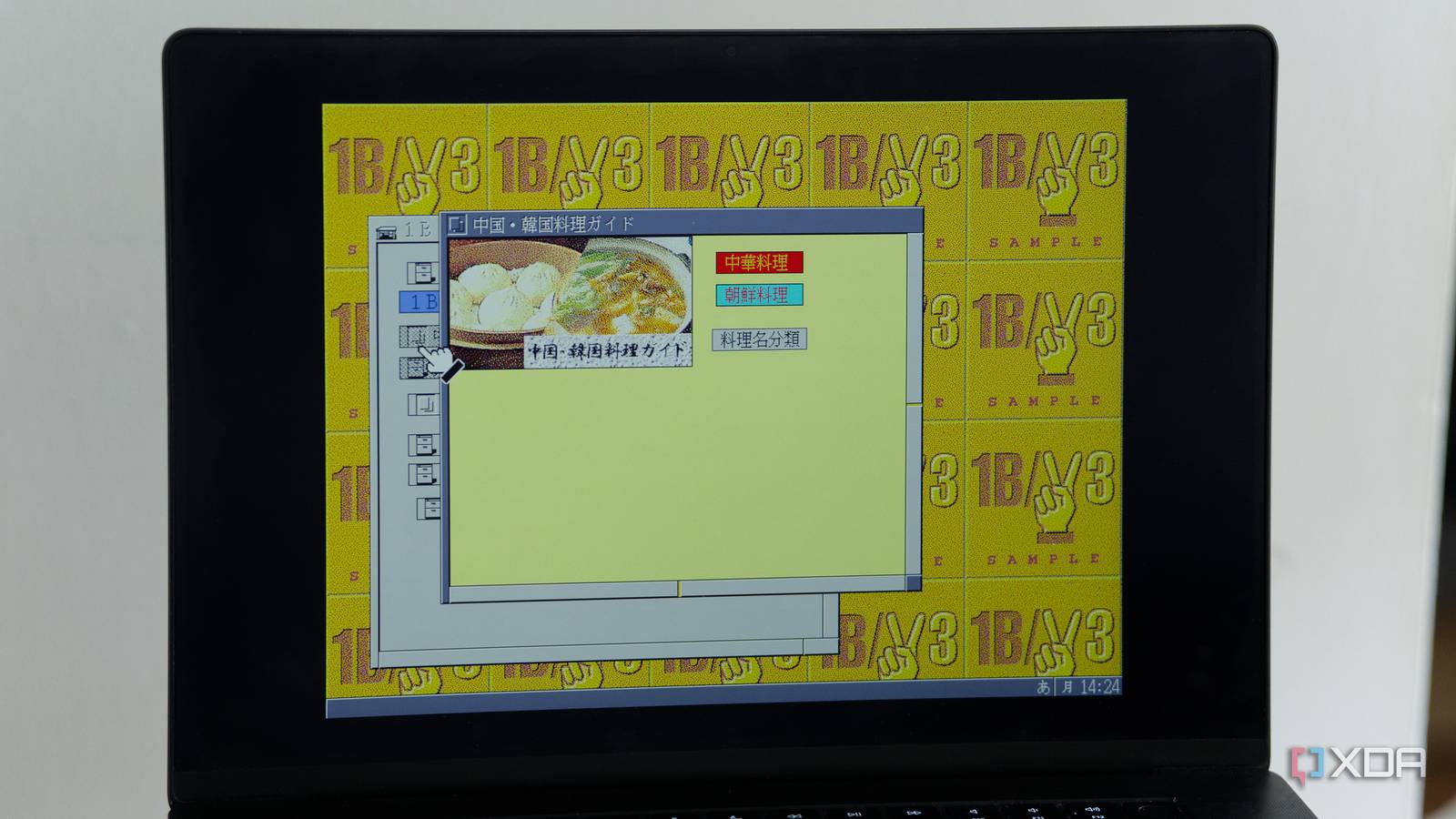
Reminds me of Microsoft killing Nokia and their new Linux phones.
Bring TRON back!
It’s time for other countries to create their own operating systems again
Make other countries create other operating systems again
MOCCOOSA
Bless you
what counts as an “operating system”? is it enough to just create another linux distro? is it enough to just fork the distro and add a new visual design to it?
(Sign) I just want other countries to create good operating systems again
I’m tired
Be honest, you just hope that the sheer amount of resources will lead to some country finally finish https://en.wikipedia.org/wiki/GNU_Hurd
We’ve been doing it for a long time. Linus is from Finland.
Currently, Linux Foundation resides in the US, though.
Was it
 because
  of this guy?


That’s reminded me, I should watch steamboy again…
Japan tried to walk where Terry Davis was running laps
did it handle anything other than documents?
No, sorry, that will take 10,000 hours of labor to implement and will not support video codecs that were published a decade ago :3
replaced the tree-structured directory hierarchy with an arbitrary directed graph.
TBH that sounds like a total nightmare
So you’re saying the US saved the world from Japan for a second time?
Yeah this OS would suck as soon as the 00s hit with the global Internet. This OS seems completely incompatible with how the world actually works and would probably collapse under its own design by the year 2010. A file is an arbitrary string of bytes. Removing the ability for the user to handle them like this is so obtuse. The reason why we can poke modern OSes the way we can is to prevent requiring a man-year of work every time we need a major new feature.
The idea was that every layer, from silicon to user interface, would be designed together, with no compatibility debt to existing platforms.
…which makes compatability debt between it and literally everything else.
A file is an arbitrary string of bytes. Removing the ability for the user to handle them like this is so obtuse.
Per the article:
According to the BTRON3 specification, the first two halfwords of an application ID are the data type it applies to, and only the third distinguishes rival handlers for the same type. When a document contained writing, a table, and a figure, opening those parts made the system launch each one’s registered handler to draw its own content inside the parent document’s window. If no handler exists, or the handler fails to draw, the system strikes a diagonal line through the region where the content should have been.
That’s a window manager with application/file associations, with the ‘window’ that the application draws to being embedded within a hypertext document. So, you’d be able to attach arbitrary hypertext to a file and when you open it the window manager presents that information along with the application window. That’s not any less flexible or more limited than any other desktop OS.
EDIT: now, it sounds like you could embed multiple ‘windows’ within the same document, and maybe do something with transclusion, but I haven’t read enough about how BTRON worked to say much about that. But that doesn’t fundamentally change what I wrote above.
That sounds like hell. The .DS_store problem but 100 times worse.
Every single mainstream operating system has metadata and index stores associated with its files and applications.
Linux has locatedb and .desktop files, and many other files that determine how content is presented to you in a desktop environment.
Windows has NTFS alternate data streams, the registry, multiple appdata folders, and a bunch of other kludges.
I dunno, I kinda fw it. Like having a tag-based system for grouping files instead of nested folders does give me less anxiety in organizing everything, and it lessens the bloat due to duplicates
Look up what a hard link is
“Capitalism breeds innovation.”
Also capitalism:
lemmings blaming everything on capitalism
also lemmings: scrolling on their apple iphone that also had a gui decades ahead of its time in the 80s
Competition breeds innovation. Commercial pressure can be one source of such competition, but isn’t the only one.
Capitalism abhors competition. It breeds innovation only if it serves to eliminate competition.
Absolutely correct, Capitalism will incentivize innovation only as long as it’s profitable to do so. Once a company becomes a dominant player in their industry, innovation actually becomes largely unprofitable.
We can see this play out all the time, this is why industry giants almost never try to outcompete smaller start ups by innovating their products and services, instead, they either crush them out of the market via a bunch of different methods. Or they just buy them out, kill off their IP, or if it’s way better, they just brand it as their own, and usually fire most of the old staff.
In a Capitalist system, this actually creates a whole new incentive structure where start ups will try to grow as fast as possible with the sole intention of getting bought out by an industry titan, making the founders of the start up filthy rich.
Capitalism breeds protectionism.
No this was capitalism in action. Capitalism bred the innovation in TRON.
Governments getting involved and putting their thumb on the scales to control the economy is the opposite of capitalism.
Government getting involved and putting their thumb on the economy is as capitalist as it gets.
South Sea Trading bubble, East India Company, Lake Eyrie Canal, trans continental railroad. Teapot Dome.
The government has ALLWAYS had its thumb on the scale for big business interests and if you think that’s not true I have a bridge in Alaska to sell you.
Right next to some beachfront property in Arizona.
I don’t understand your comment.
You’re listing things and going “BAD” so Capitalism is bad.
A trading bubble is really just economics. Can’t really say Capitalism causes that. The East India Trading Company is mercantilism which as evil as that specific company was the idea of trading goods from one country to another is like the core of our entire economic trade system today. Teapot Dome was flagrant corruption which happens in any economic system, the Canal and the railroad are more examples of labor exploitation which you can easily argue was less bad than the labor exploitation that came before it and led to better labor laws in the country.
It’s like you’re pointing at a gun and saying “FIRE MADE GUN, FIRE BAD!” because guns kill people. It’s pretty caveman.
No this was capitalism in action. Capitalism bred the innovation in TRON.
Governments getting involved and putting their thumb on the scales to control the economy is the opposite of capitalism.
did you read the article? TRON was heavily backed by the japanese government.
Say the line!!
“That isn’t REAL captialism”
Lmao
Just like the dumbasses say “the Soviet Union wasn’t REAL communism”?
Except I’m correct. A government implementing protectionist policies to control economic sectors is not capitalist.
Yes it is - capitalism demands that in fact. You’re thinking of free-markets. Capitalism inevitably destroys free markets.
Yes it is - capitalism demands that in fact. You’re thinking of free-markets. Capitalism inevitably destroys free markets.
Lets see if we can agree on some definitions.
What you’re describing as “free-markets” I know as laissez-faire capitalism. This definition came from, unsurprisingly, the French in the 18th century and was used heavily by Adam Smith in the book The Wealth of Nations. I think we all agree there are very few, if any, true large scale laissez-faire capitalism in operation today.
What have in most places is regulated capitalism where there are government rules that change the outcome to a different outcome (sometimes better/sometimes worse) that would have occurred under laissez-faire capitalism.
Are we in agreement with these definitions or do we still have discussion needed to arrive at the same place?
OK sure - if we’re being strict and academic about this - perhaps it would be more accurate for me to say that capitalism in the pure platonic sense doesn’t really exist, and tends always towards crony or state capitalism where the power of the state is used to funnel money and power towards the holders of capital rather than to provide a free and fair playing field for economic actors.
perhaps it would be more accurate for me to say that capitalism in the pure platonic sense doesn’t really exist,
I agree with this without any reservations.
and tends always towards crony or state capitalism where the power of the state is used to funnel money and power towards the holders of capital rather than to provide a free and fair playing field for economic actors.
I take exception with “always”. In the USA for example, there have been many notable exceptions where state capitalism implemented protections from abuses that pure laissez-faire capitalism would have allowed. The National Labor Relations Act was a state action that allowed for collective bargaining of workers. More recently the Consumer Protection Financial Bureau acted as an agent against uncheck capitalist forcing a fair playing field.
I’d probably agree if you changed your word to “frequently” though.
Government tipping the scales to help their capitalist mates seems to be exactly how capitalism works.
And North Korea is definitely a democratic republic 🙄🙄
Except I never said you were factually incorrect, since that seems to be the most important thing for you to get out of this exchange.
It is capitalism. It’s all part of the system.
One of the biggest lie to keep the current system in place.
Private corporations parasite themselves into R&D paid for by the government and act like they invented the fire again.
The Internet is built on FOSS and got captured to be sold back to us.
Capitalism breeds innovation just like people leave their partner when they finally have enough to be abused.
That tracks.
The more I learn about American history the more frustrated I become with our species in general. Our country could be so much more livable now, but for a handful of vulgarly wealthy people who only ever cared about number going up at any cost.
on behalf of humanity, we aint claiming those shitheads
All of our lives could be so much better. We should stop making dystopian futuristic movies, and start making hopeful ones that help people imagine how much BETTER things could be.
Yeah but nobody would watch it
Solarpunk instead of Cyberpunk!
Yeah let me find 20 million dollars to make that movie
You can just vibe-direct it with AI for the irony! And the lulz!
(/s, please no one do this 😐)
It only costs like a few million, the rest is for embezzlement and fraud.
And once upon a time there were more than three PC graphics card makers. The paranoid schizo US really fucked up scientific and technological progress.
have you heard of Macintosh? you’ve heard of Mac’s right.
little company called Apple? lol sheeeesh
Apple only makes garbage
There also were more than two PC platforms (and we barely have two now; Apple was pretty close to going away too). I miss being the Atari ST guy in a circle of people who all had different types of computers. It didn’t last very long but it was way more fun.
They rose to the top because they were the only country that could still build things after the rest of the world got flattened in World War II. Then the rest of the world rebuilt itself so the only asset the US had left was economic inertia. They then proceeded to spend decades doing everything they could to increase the value of that inertia by using their influence to encourage policies that resulted the rich getting richer.
And now it’s over, well it might take a decade or so but Europe is rebuilt and the USA is shitting its pants(not because they’re scared, just because it seems).
And when the Eastern Bloc dissolved, government owned corporations got sold off to western ones, for pennies, all to be shut down in a few weeks. If not, usually they got boycotted, because the kids finally could buy western brands, which made you look cool among your peers.
Eastern Europe sold its stuff away mainly because of local corruption. Local factories would get sold as scrap by one wise guy and a couple of his friends in the budding government fresh after a revolution because they could make a quick buck and set themselves up for more similar opportunities. Also “scrap” claim would take a long time to be investigated and never amount to anything.
Is it available on the internet archive or a computer museum site to try out the UI?
Interesting how many TRON Association members were also adoptees of the MSX standard, which had similar (but less ambitious) goals to be “the” world computer interoperability standard. i wonder if that was why they jumped off the project at the first sign of trouble, thinking it was a good thing they didn’t keep all of their eggs in one basket. NEC likely ended up outperforming them both with the PC-98 anyway
I know web design isn’t really related to what the article is about, but if modern Japanese web design is anything to go by, good. Here’s some random product (a phone case) I clicked on from the biggest Japanese online store (Rakuten), roughly the equivalent of amazon. Let me know if the product info seems well organized and easy to read, and tell me how long it takes to find the section that you can choose a different color and model (hint: it’s not at the top or bottom of the page).
As a Japanese guy with a Western upbringing, the Japanese website bother me too, but it obviously doesn’t bother people here enough that the companies need to change it. They just grew up with a different way of processing visual info.
After dealing with MS’s shit UX all day, that looks pretty good. It seems pretty average for a shopping site.
I dont speak Japanese. is it this?

Yeah that’s it. They like to put it in the middle of the page for some reason.
Every other Japanese site I’ve looked at had a lot more information density than this. Looks like they’ve been plenty affected by crappy modern design.
If you view it on mobile its right at the top under the price
Yeah on mobile I think it’s okay. Still a bit overloaded but a far cry from what Japanese web pages can be like on desktop browsers. Sometimes they’re like web design stopped in 1999 and since then all they did was add more blinky banners around the actual content.
It’s almost like they have another culture than North American or European…
And that culture is “random shit thrown all over webpages”? Japan still used a lot of faxes up until about 10 years ago. Maybe it’s just that old people are mostly in charge of things and the society is still largely catering to the whims of random old men who aged into their positions rather than earning them.
I don’t really understand what you’re trying to say, here. Why does Japanese preference for web marketing bother you that much?
What do you mean by “web marketing”? In most countries they’ve moved onto web 2.0, but Japan is still mostly stuck in the past and lots of their sites look worse than random angelfire webpages from 30 years ago.
Have you considered that Japanese consumers like it that way?
Have you considered that they don’t? Microsoft and google are all about anti consumer in service of ad revenue and selling user date in their products these days, but not many people are arguing that US consumers enjoy spyware and less functionality than we had 20 years ago.
Did someone ruin your day or something? What is your problem with web pages from another country? Why do you care?
Japanese customers genuinely do like it like that. Rakuten do A/B testing up the wazoo just like every other big ecommerce company.
I dunno, amazon japan doesn’t look anything like that and I’m sure they do just as much testing.
It looks exactly the same as Amazon in every other country. That’s a not a good counterpoint.
So amazon doesn’t do extensive testing in countries other than the US?
see now you’re just being argumentative and indulging in mental gymnastics for its own sake.
how
ed: Allow me to expand: you think rakuten, a company with billions in revenue, does testing in the Japanese market, but amazon, another company with billions in revenue, refuses to do so? Who’s doing mental gymnastics here to preserve their idealized image of Japan?
No the point is that a Japanese focused company can optimise for a design that works best in Japan without having to consider how other people would interact with it.
A multinational like Amazon has to balance what works best in a particular market with retaining a consistent identity across markets and having shared functionality between different locations.
It’s funny because I trust the Japanese government even less that the American government.
I suppose I’m not that up to date on Japanese government and politics. Can you elaborate?
They refuse to admit all the horrible things the country did during WWII.
They have a weakness for the sneak attack.
They paid for that already and your comment is disgusting but expected from an american.
They absolutely have not paid for a single atrocity committed during WWII. The government refuses to admit they happened, let alone take responsibility.
I am not an American, your own prejudice seems to be showing. But of course you overlook that.
And I wonder if it was a Unix-like operating system
If you can’t read, guess you’ll never know.
Then no