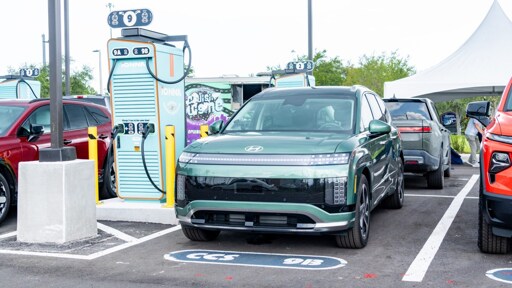
I prefer the idea of plug it on and go get lunch and take a piss and have a stretch, rather than have to stand there with it for a few mins and then do all that other stuff.
The few times I’ve charged an electric rental car, I had to go pee and buy snacks or go for lunch anyway… in my opinion a longer break of a few minutes from driving is healthy and safer anyway.
Right, the more you plan ahead, the more efficient you become. First, I look at where chargers are located, then I choose restaurants, grocery stores, shopping malls, hotels, based on those locations. Even sports complexes and community centres. But if you charge at home daily and stay in the same city, you don’t even need public charging at all. Highway level 3 stations are those that really matter.
In three years of ownership, I have used a fast charger once. A sudden unplanned road trip when I had let my charge get low.
Charging at home is so much nicer than a gas station. It is worth the rate longer fast charging on a road trip to usually not to go to a gas station at all.
If I lived in an apartment, I think I might be pretty frustrated though.
My apartment complex has a power outlet (and meter) at every parking location. It’s not hard to run a wire from the lamp, specially when there’s a reserved space per occupant AND high trust that your neighbors wouldn’t mooch of yours.
PS: it’s not a real utility meter, more of a bodge/jugaad but it works well enough
I’m fine with waiting. Thing I wonder about is, how many vehicles can charge at a station at a time? Can you just make a parking lot with plugs for each space? If so, I’m good. Where’s the snack machine—
My goal is 3 minutes or less for every gas station stop.
Great. Charge at home, then you can spend as long or as little in a gas station as you want.
Unfortunately some of us drive further than a charge on a weekly basis. I travel for work
300 mile days happen weekly
Plenty of electric cars out there now that can do 300 miles to a single charge.
Plenty of places you could drive to, plug the vehicle in, go about your day and let it charge while you’re busy doing something else. Fuel stations meant we had to be with our cars while they were refueling. That’s no longer a necessity.
In the event that you are in the extreme minority that really cannot work with an electric vehicle shrug stick with liquid fuel until that changes. But there’s no reason to stop the other 90% of the population getting on with a better technology for the vast majority of drives out there. It takes a small change in thinking, that’s all.
My partner (in the UK) has a 110 mile a day round trip commute. Work got her an electric van with a 150ish mile range. Annoyingly she also has to do 30-40 miles a day while at work. The math just doesn’t work out. However, if her work put a charger on the house (which has tax implications) a fast charger in the work yard, it would work out just fine.
The tech isn’t impossible, the tech just needs a little refinement to cover the small percentage of uses cases left that it doesn’t work. Yet people focus on the handful of times it’s a minor inconvenience, to write off a while developing and improving technology.
That’s a weird goal. I’ve never thought about how long I’m taking at a gas station. If I’m just getting gas it’s a very efficient, straight forward process that I’ve never felt the need to time or rush.
Most of the time, they don’t need to be anywhere near as fast as gas (most, maybe even nearly all, people have or can have a way to charge at home). But there’s lots of people that don’t do long stops on their trips and just want to stop, fuel up, and go. The EV can be a bit slower, but anything over about 15 min is going to be a showstopper for alot of people.
I mostly agree but part of me thinks you can get away with below 80% charges to save time rather than being hung up on the time to reach that 80-100%. (shifting one’s thinking like how EV roadtripping is currently about reaching the next charger rather than a 100% fill each stop)
I say that because some gas vehicles like the two-door Bronco just have relatively poor range (in the 200’s) due to smaller tanks and I’ve seen how long folks can wait in line for gas at Costco. (having also been in line)
(most, maybe even nearly all, people have or can have a way to charge at home)
What? Most people where?
I live in a fairly rich European country, and EV chargers here practically don’t exist. Almost everyone lives in apartment buildings. If you’re lucky, yours will have 1 or 2 chargers in the underground parking lot or somewhere close by outside.
It’s even worse in Eastern and Southern Europe. Outside of North America, Europe, and China, EVs, as well as chargers for them, don’t exist at all.
Are those ‘most people’ you’re talking about actually just <5% of human population that happen to live in North America or Western Europe, and happen to be wealthy enough to afford that?
So many people will get gas then go in for snacks by the time you wait in line and get gas that’s 20 minutes alone.
I was arguing with my mum and she said it can take twenty minutes to recharge the car. I said, after driving for five hours don’t you want to get out, stretch your legs and have a coffee? That’s half an hour easy.
And that’s why battery swap stations should exist.
Give me an option to quick-swap modules ;-;
It sounds way too easy to do.Only issue I see: How to make all manufacturers agree on the battery form?
Many people don’t enjoy having to regularily go to the fuel station, but they have to. You do not necessarily have to do that with EVs. Habits form around necessities.
Yeah I fucking do. I’m at Costco of BJs just long enough to fill the tank, and then I’m off.
Why not charge at home? You cant be making 100km trips a day
The great majority of my gas stops are stop, fill up, leave. I expect those would be eliminated by having a EV I just charged at home though.
For the cost of running a washing machine.
Hmm. There’s many ways that could be a lie. Could I get a source?
A source that a car and a washing machine both use 240V? Sure you could.
Pretty sure that beats the $40 to fill my tank by quite a lot.
The calculation is too difficult?
I don’t know how much it actually costs to run my washing machine so I cannot make a definitive statement.
Like EV charging, washers and dryers run on 240V. My approximate energy use for a laundry load (washing + drying): 3 kWh. My own EV driving uses about 5 kWh per day. That’s how I got the number. Same order of magnitude is my point. At least in my case. Changing the laundry size and frequency, and driving habits, could actually make those numbers (3 and 5 kWh) close to equal.
I wasn’t trying to argue with you.
I’ve got a Rav4. Costs about $40 to fill up. Just got a Subaru Solterra (same vehicle as the Toyota bz4x). Costs about $7 to charge, given my electric rates. Similar range (Solterra is a bit shorter). And that’s neglecting my solar.
Depending on the state, I’d much rather have a bio break, snack, and stretch my legs at a rest stop. Picnic benches, shade and a view, even a pet relief area. Many have water stations to refill bottles. Does require I’ve stocked the car with meals and snacks. In general filling stations lack the nicer amenities, most just suitable for gas and go.
Source: Just did 6338.5 miles encompassing 16 states.
There is a beautifully located DC charger overlooking Lake Geneva (of Smoke On The Water fame)
Imagine if you could just hop on a train to achieve the same thing. EV Charging doesn’t need to exist because personal vehicles don’t.
I imagine the trip I just took would be a ridiculously difficult logistical nightmare. I had two seventeen foot long kayaks, camping gear including stove fuel which is a hazardous material, I visited multiple wilderness areas in rural areas.
Around home, taking a short 15 mile trip to the beach with just the 17 foot kayak is impossible on bus or light rail. I support the rebuilding of the US rail system and public mass transit but some use cases fall outside practicable.
most of my longer drives are 500 to 600 km with one or two short stops along the way.
if there were a wagon that could start fully charged, and leave me with 250 km of range at my destination after those two short stops, I’d be interested in it as my sole vehicle
I don’t really see how it would make this work for me without that capability. I don’t do daily commuting so that aspect of charging at home doesn’t appeal to me — I already only fill up maybe every other week at most
Something like the XPENG G6 comes to mind.
- 800V platform, so very fast charging speeds
- 80kWh battery with realistic range of 450 km
On a ~680km trip you can make 2 short charging stops (13 minutes each) and arrive with 60% battery (>250km range).
Although I’d challenge the assumption about having to have 250km left at your destination. Just plug it into an AC charger or even just a standard AC house plug at 2,3 kW. Idle time is free charging time.
So you could actually make that trip with two short stops under 10 minutes each.
Caveat: there have to be ≥350 kW chargers available along your route
yeah I’m thinking of backcountry trips where I have to drive 1.5 hours out afterwards before I reach any gas station, and there is no charging available where I’m parked for a few days.
The thing a lot of these people dknt understand is that not everyone has a garage where they can charge a car. I love in an apartment, where am I suppssdd to charge an EV? My parking space is too far away from my parking spot to charge, and I’m positive that my complex would never pay to add charging spots connected to each apartments meter.
Even if they did, I wouldnt trust my neighbors to plug tjeir EV into my charger. This alsomapploesmto people in houses that don’t have a garage. An I supossed to run an extension cord to the street st night so that anyone driving by can llut into my electricity?
It’s not a technical problem, it’s a people problem. We know how to run wires, count electrons and keep stuff safe behind locks (digital/normal).
Issue is (a) getting someone to pay for it upfront while you could pay for it in your rent (b) getting everyone in apartment to agree to a rent increase if they have a parking spot
most EV chargers can be locked so only you can use them (normally with a RFID or BLE tag).
Also, having chargers in apartment parkings is absolutely viable. it is more expensive to install than in a house. Not sure about the US but where I live (Spain) I know people that have them without issues
This is absolutely a valid concern.
There are various available solutions, but little incentive for landlords to bother. Either ev charger for every renters parking spot with some mechanism to lock it out (expensive) or a large pool of chargers that are shared, but you have to badge in and get it billed to you. The latter if too small barely helps and if too large will piss off gas vehicle tenants that hate the “wasted” space.
Not that it answers all your questions, but many EV chargers have access control. The Chinese one I have you have to tap an access card. Tesla charger allows you to limit to Tesla only or even specific Tesla VIN so you can just plug and change while others can’t.
It takes 20 mins, and many grocery stores have chargers, plug in when you do your shopping
Grocery store chargers are usually Level 2. I can typically recharge enough to cover my round trip to the grocery store while I’m shopping, but you’d have to camp there for 9+ hours to full charge.
Most grocery stores here don’t have chargers. If they do, its like 6 spots and theyre always full. Now, how do I charge an EV?
Hell I’ve never seen one at the grocery stores in my area. In fact in the whole city I can only think of one place that has EV Chargers it’s a shopping center that I only go to once a year maybe. Its got like 6 or so Tesla chargers. There could be a couple others, but I’ve never encountered them.
I live in a cold climate and so my apartment stall is electrified in order to run a block heater. The way that it works here is that I am charged for power usage off of that stall outlet, but my unit has a breaker that allows me to turn it off and on. I think charging ports could operate similarly, hopefully offering some kind of smarter scheduling that allows you to only have it active when your car is in the stall and needs charging.
And you think the apartment complexes are going to foot the bull to install that here? Every parking lot would have to be torn up to install that. Its a ridiculous assumprion.
Cutting a narrow trench so you can run electricity out to parts of the parking lot you can’t get to otherwise isn’t exactly a big deal. Utilities do that sort of thing all the time. We can patch parking lots - we do it all the time. Or even just put a pole and run the lines overhead. And, in many parking lots, you can just run the trench or conduit around the edge of the parking lot. You also don’t need every space to be electrified, at least at first.
Why would a parking lot need to be “torn up” to add a power outlet
Because the parking lot is paved? And you have to break throigh that pavement to run power lines?
You don’t need to break up the pavement to add chargers. Indoors they usually add chargers to the wall spots, outdoors add them to (solar paneled) shade structures.
“And while China’s getting there, an executive in the U.S. aren’t so convinced that’s true.”
Why does this sentence bother me so much?
Probably the grammatical incorrectness of it
Like an executive will be driving himself anywhere.
I mean. That’s kinda the root cause of Range Anxiety.
Even if it was double the time to charge when compared to filling a petrol car. That would go a long way.
Gasoline cars need to accept grass if they are ever to be a viable replacement for a horse. Like, what if you’re far from a gas station but there’s a meadow right there?
Only fringe enthusiasts can own a gasoline car that doesn’t have a biofuel fermenter attached.
Wrong.
It’s a dumb take on the face of it; splash n dash trips are extremely common, that’s why they put points of sale on the pump stands. It’s common enough for people to want to pay at the pump rather than ever walk into the store. Extremely common weekly errand.
Now, with an EV, likely charged at home every night thus starting most trips with a full battery, that should sharply reduce routine visits to gas stations. That leaves refueling on longer journeys. Which varies.
Me personally traveling alone, I’ll still do quick splash n dash stops on medium length journeys, say 200 miles or so? At interstate speeds that’s about 3 hours of traveling, I’ll use the restroom before setting out and one 5 minute fuel stop will do the distance.
Now, if there is a planned stop, say on a 400 mile trip, I’m gonna stop, bathroom, grab a snack and a drink, and fuel the car. That’s maybe a 15-20 minute stop to use the bathroom, grab a gatorade and a bag of funyuns from the convenience store, pay the clerk, walk back outside, then stand there at the pump while the car fills.
I will grant you, you can plug in your EV and have it charging while you’re in the store, but none are going to charge in 15 minutes. So you’re going to end up just standing there, or sitting there, while it finishes charging. With nothing at all to do. Even simulating the same behavior as with a gas car, stand there next to the charging cable staring at the price going up for ~5 minutes, the car’s not going to have taken on enough power.
I have refueled my car at night at unattended gas stations. Sitting there for a couple hours while a car charges enough to reach the next station sounds real fun.