

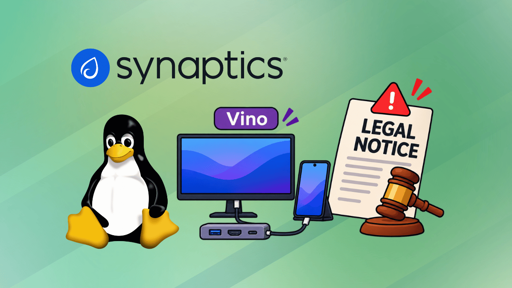
Before we dive into the matter, you first have to understand what DisplayLink is. It is a proprietary graphics transport technology that lets computers connect to one or more external displays over USB, using docks or adapters built around DisplayLink chips.
It works by compressing display data on the host computer and sending it to a chip in the connected device. The chip then decodes it for output to monitors through interfaces such as HDMI or DisplayPort.
On Linux, this support can rub some people the wrong way due to its closed-source nature. That is where Mike Lothian’s (FireBurn) Vino comes in as an open alternative.
Unfortunately, Synaptics owns DisplayLink and has sent Mike cease-and-desist letters alleging that he infringed its DisplayLink patents with his project.
What’s Vino?
Vino is a driver that lets the Linux kernel talk to DisplayLink docks directly. It is meant to replace DisplayLink’s closed-source software and the open source EVDI kernel module that sits beside it.
Mike wrote it with help from Claude Code, and the first version reached the kernel mailing list in June, unfinished. He had faced a communication issue between the dock and the driver and asked other developers for help.
In early July (courtesy of LWN.net), he emailed a Synaptics employee for guidance and mentioned his Rust rewrite of EVDI. About two weeks later, a different employee replied.
That reply said his Rust rewrite of EVDI was not a thing of concern. Rather, the concern was the DisplayLink protocol and codec, which Synaptics believes are covered by its patents. Lawyers get involved
A cease-and-desist letter followed on August 17. It told Mike to stop development and withdraw anything he had submitted to maintainers and hosting sites, with a signed confirmation due by August 28.
An appendix listed over 125 patents without saying which applied. Mike posted a working version 3 of Vino on August 26 and asked Synaptics the next day which claims they had in mind.
The answer came in October as claim charts. They map one claim from each of two patents, GB2484736 and GB2485613, to his source code.
The October 5 letter said Synaptics would seek $25,000 for the cost of preparing those charts if Mike missed an October 11 deadline, with the figure rising by at least $25,000 each week.
Mike replied on October 6 (message 8) with an offer to pause public work on the encoding code the charts point to if Synaptics paused the deadline and the weekly charge. He also asked about licensing that code for non-commercial use.
On October 7, Synaptics said it would grant no patent license or promise not to sue and set October 18 as a final deadline.
 What I can see so far is a very aggressive patent infringement witch hunt against a lone open source developer who was quite open to communication.

 Synaptics took about three weeks to answer his request for specifics, then followed with a potentially life-ruining $25,000 demand that compounds weekly.
Clean room design quirks
Mike describes Vino as a clean-room driver and says he reverse engineered it from captured USB traffic and vendor programs.
If you didn’t know, in a clean-room recreation, one party studies the original implementation, then writes a description, and a separate party builds the new code from that description alone.
It is meant to act as a defense against copyright claims because it shows nothing was copied. Synaptics’ July reply argues that clean-room or independently written code can still infringe a patent.
The timing
Vino also lands in a busy stretch for AI-assisted reverse engineering, from smart TV cleanups to office suite clones. Legal pressure has reached other AI-built projects too.
Mike has already taken down the Vino repository in response to the demands, and Synaptics has not made a public statement so far.
Only time will tell what happens to the work, and I hope someone forked it before it went offline, as that would give others a good starting point to build on.
You’re completely misunderstanding their point.
I think you are, my man. Go back and read what he wrote. He’s arguing that it is immoral to charge money for a digital good that can be copied easily without destroying the original. In other words, software. He said all software should be open source, and the only way anyone should make money from it is donations. He said that the value of the labor of a software engineer is zero because the product of that labor can be infinitely copied. (This would include the value of the labor of all artists, btw. Musicians, voice actors, authors, 3D modelers, graphic designers, CAD engineers, journalists, photographers, etc. Anyone who produces works that can be represented digitally.)
I am simply pointing out an unfortunate fact of how digital goods work. I am not saying your labor has no value inherently, but that because the product can be infinitely reproduced it becomes so diluted as to approach 0. Imagine an artist made a sculpture. It has immense value because it was very hard to make. Yet if they could snap their fingers and create 2? And then 20? 200? 2000? Suddenly its not worth very much.
It’s even worse because with digital goods anyone can do the copying.
The reason I say the current model of proprietary software is exploitative is because it attempts to legally enforce a monopoly of this infinitely reproducable commodity in order to extract infinite profit from society in exchange for its use.
I will clarify about the monetization model. If you wanted to write some code, then tell people they can access it for a set fee, and once accessed it has no DRM, no restriction on copying, etc then that’s fine. It’s not the act of asking for money in itself but the act of attempting to claim ownership over all the infinite copies I take issue with.
There are many ways to monetize something without doing that. One of them is asking for donations. One is the single payment before access to an unrestricted product model above, and there’s all kinds of other ways too.
I do understand why you are upset by what points I made. I just think that you are wrong that we need to be fully communist to implement a different model. Many of the current issues with open source not recieving many donations, and not having much in the way of support is because of the massive companies with proprietary software that absorb all the software markets value for themselves. This also fragments the software infrastucture of society.
Most of the funding for software in general comes from huge companies. But they lock down the things they pay for. So nobody else can use them. This means open source devs have to reinvent the wheel to get anything done. If you got rid of the proprietary model companies would still have a need for software, and would still pay to have it made, but their software could then be repurposed for other uses. Developers would get paid for their initial labor by the companies and then the product is out there and can be copied for free by everyone else. This does not require communism to work. It just requires restrictions on how software can be locked down.
Now as to the personal point. You asked above to list all FOSS software I use and say how much I’ve donated. I can’t list everything. I assume that was a point you were trying to make about the invisibility of things like libraries. So how are they meant to get donations? I use Debian. I give money to Debian. Not much, but I try to give them 5-10$ every year. I’m not a wealthy person. In fact I live below the poverty line. But I do this anyway because I appreciate what Debian does. It’s my opinion that the way this should be structured is as follows:
Visible Software (OS) -> Infrastucture A -> Infrastucture B
Visible Software collects donations. It has the visibility to request them. It should then be required (by law? by expectation and social pressure? We would need enforcement, I am aware.) to have a list of attestations. What other FOSS projects made their project possible? To what extend did they do so? Then Debian in this case would need to take their 10$ donation and divy it up. Infrastucture A was used by them then is given 1.50$ by them from that 10$. If Infrastucture B was used by A then A would need to figure out how much they helped it and pass on some to them. Say 50 cents. This would act like a donation dispersion model where a donation to Debian is a donation to all the infrastucture that makes Debian possible by proxy. This is sort of how Debian works now tho I don’t think they have it down to quite a science.
Hopefully this clarified my position for you.